Skip’s Quips: ‘Sunshine’ Ain’t So Super, Man

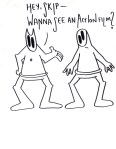
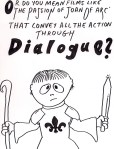
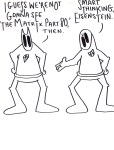
Blog Sketch 082813Every so often when I see a movie, I get really, really disappointed that someone didn’t make it better.

That’s how I felt after viewing the Danny Boyle-directed Sunshine,  an ambitious sci-fi film that should’ve been excellent. It left me feeling dismayed at all the ticking clocks (the flick has something to do with a human space expedition to save our solar system’s dying sun, which seems to be capitulating at the very moment the picture is going on … a rather frustrating, action-movie-esque part of the plot), flashy cinematography and mumbled dialogue, despite the interesting story. We definitely need thoughtful, adventurous science-fiction films in our cinematic diet, so this one was especially problematic for me. A good idea that fell short.

I’m just wondering why director Boyle couldn’t have trusted the material more to avoid the pitfalls that race-against-time flicks often go through. There was a lot of breathlessness going ’round, and I would’ve preferred something more tranquil. Plus, the science seemed off … even to this completely unscientific movie critic. That’s an issue in science fiction, a genre in which a good movie achieves credibility however outlandish its foundations may be. In that regard, Sunshine left me cold.

Too bad. I wanted to like it. The flair, however, just wasn’t there.
Skip’s Quips: Hey, ‘The Long Kiss Goodnight’ Isn’t Terrible!

Blog Sketch 082813I admit: I was convinced to watch this movie by my wife, who emphasized how good it is.

But I was skeptical. Trudi and I have different tastes in film, though we do share some opinions. (For instance: We both agree that Manos: The Hands of Fate is awful, though that’s like agreeing that the sun is hot.)

The Long Kiss Goodnight, however, didn’t seem like a movie she’d like. It has fight scenes, which is a no-go in her book. It’s an action film: double-yuck.

Needless to say, I was puzzled. I sat down to watch it with trepidation. Then I enjoyed it … with no trepidation. Fun escapist nonsense. Doesn’t take itself seriously. Not a bad script, with some sharp lines. Slick direction by Renny Harlin.

OK, it’s far from a masterpiece. It’s action without profundity, the antithesis of, say, The Wages of Fear. Yet it was something of a lark, and I succumbed to it. Do I have bad taste? It’s kinda out of my jurisdiction.

Nah. I have a bit of Trudi’s taste in me after all. And that’s good, because it balances me out.

I repeat after myself: I. Like. A. Trudi. Movie.

Skip’s Quips: Cameras, Trains and Automobiles

IBlog Sketch 082813s there a better car chase in the movies than the one in The French Connection?

The subway-centric scene even beats the famous San Francisco-set sequence in Bullitt, in my opinion, and though the riveting desert ride in Raiders of the Lost Ark comes close, the originality of the shots in Connection makes it tops. A camera mounted on the hood so you can see where the car is speeding—superb, risky work.

And to think it was all done without CGI, huh? How did we live?

Well, I think, is the answer, with scenes such as these.

Setter’s ‘Spectives: The Shot Not Seen ‘Round the World

Setter Drawing for Blog 082613The best shot in all of cinema may be one that’s hardly remembered.

It’s one that I think about periodically when I ponder great filmmaking. Of course, it’s from The Seven Samurai, one of my favorite movies. But it’s not from a famous scene.

Instead, it’s an image from a sequence toward the beginning where a number of farmers are in town to recruit samurai. They’re staying at an inn and discover that most of the rice that they’re subsisting on has been stolen. If I remember correctly, one of the farmers–Rikichi (played magnificently by Yoshio Tsuchiya)–gets angry at his comrade, Yohei (Bokuzen Hidari), who was supposed to watch over it, and throws the last handful at him.

Then comes this great shot, where we see Yohei start to pick up the grains, one by one, from the floor.

Why is this so brilliant? It’s one small, short shot, but the impact is monumental. It tells you everything you need to know about the farmers–that they’re so desperate, poor and hungry that they’ll even try to save a few grains of rice to eat them … the last they have left. They can’t afford to waste any. And director Akira Kurosawa shows this horror by focusing his camera on the floor, as Yohei tries to retrieve the rice.

Absolutely compelling.

There may be more famous shots in the movies, but this is one of the few complete ones, an image that gives us all the information we need, plus a haunting picture, without telling us straight out why. No surprise, then, that I think about it often when I muse on all things cinema.

If only more directors would learn from shots such as this, the movies would be a better place.

Setter’s ‘Spectives: Bring Back the Blood Squibs?

Setter Drawing for Blog 082613I don’t know about you, but every time I see an action movie these days, I expect the gore to pepper the screen with pixels.

It’s hard to run away from computer-generated imagery. It’s all over TV–from commercials to ongoing series. And it pervades the cinema, where it has become, in some cases, the main reason to see certain pictures.

Yes, filmmakers can do things with CGI that couldn’t have been achieved 40 years ago. But is that always a positive? Are we relying too much on high rather than low technology?

I worried about this recently while watching Life of Pi, whose CGI animals—especially the growling, boat-hogging tiger—had a gloss and fluidity of movement that seemed slightly off. It was a solid technical achievement, surely, and the cinematography was often stunning. Yet the animals seemed less “real” than the fighting skeletons in Jason and the Argonauts. The tiger showed its stripes.

That doesn’t mean I think we should go back to adjusting models frame by frame and discarding all cinematic developments … though the process of creating CGI creatures may only be slightly less onerous. But I do think something’s missing from most of the computer-crafted images used today, whether it’s a tiger or a snowflake. It’s not just naturalness; it’s essence. Those battling skeletons—ludicrous as they may be—draw me in. That smooth-purring tiger doesn’t.

Somewhere Bruce the shark is rolling his dead eyes.

Setter’s ‘Spectives: A Modest Small-Screen Proposal

Setter Drawing for Blog 082613Any reason why we can’t have the all-Kurosawa channel?

We have action on demand. Drama on call.

Well, I want to snap my fingers and have The Seven Samurai appear on my TV instantly.

I get hankerings all the time for this glorious, seminal movie. And it seems to be rarely on. When it is, it’s often at a time when I’m not available–like at three in the morning or 18 billion, trillion o’clock in the afternoon.

Why don’t I just get the DVD and stop complaining? OK, I’ll tell you. There’s something really organic about turning on the telly and finding a movie you like. It’s satisfying.

Satisfying in the way that getting up to put a DVD in the player isn’t.

Fine, I’m lazy. But it doesn’t change the fact that I adore this Kurosawa classic. Which means I also scoff at the 1960 American remake, a poor imitation that removes the vital class distinctions pervading the original (samurai versus farmers) while adding more guns–weapons that make such a difference in its Japanese progenitor–and subtracting most of the character development.

If I could have The Seven Samurai broadcast to my brain personally on a 24-hour basis, I’d do it.

An all-Kurosawa channel, admittedly, might not make financial sense. But maybe … an all-jidai geki station? Bring me the popcorn.

I know I wouldn’t be the only audience member.

Let’s Get Our Definitions Straight, OK?

Setter’s ‘Spective: The Slo-Mo and the Furious

Setter Drawing for Blog 082613I blame you, Akira Kurosawa.

Remember: You started it. Or rather, you helped popularize the use of slow-motion photography in fight scenes–specifically via two different shots of villains dying in The Seven Samurai.

I adore your films, Akira. But I’m not happy with the seeds you’ve sown.

Ok, so you’re not responsible for all that ludicrous pseudo-Spartan posturing in 300. Or the (prolific) guts and glory in The Wild Bunch. But without those scenes in Samurai, we wouldn’t be so deluged with half-speed onscreen violence.

Granted, you used slow motion judiciously–and I think that’s what separates you from the rest. Peckinpah’s technique can hardly be called subtle, but his Bunch certainly packs a punch. Not so much all that silliness in 300, where the idea seemed to be showing how cool it is to kill ancient Persians with as much CGI blood as possible.

And I think that’s where all this slo-mo falls rather quickly on its face.

We’ve diluted its purpose, the whole point of its effectiveness. See it once in a while, and it’s as startling as a flower in snow. Yet watch it over and over again, and it loses its potential impact. Today, it seems to be de rigueur in “action” scenes, as if directors have forgotten how to film normally. So it has become showy instead of telling, obvious instead of shocking.

Frankly, I’d rather see My Dinner with Andre. That’s got more action than any Matrix pose-a-rama.

So Kurosawa, I’m going to take time out from praising you to gripe a bit, though with a heavy heart. Because I know as much as I loathe what slo-mo has become, without it we wouldn’t be what we are today.

Old man Sykes says in Peckinpah’s Bunch: “It ain’t like it used to be, but it’ll do.”

I don’t think it should.