Setter’s ‘Spectives: How Glib Was My Movie

Setter Drawing for Blog 082613Trying to watch Celeste & Jesse Forever is hard.

I don’t like movies like this. Glib, smug, self-conscious. Snarky, unfunny humor.

Tough flick to get through. Oh, and it’s something about a couple in the process of divorce who still behave like a married pair. What a concept. Bleah.

Too bad, too, because there’s talent involved in this Lee Toland Krieger film, including Andy Samberg and Rashida Jones as the not-so-doomed lovers. The components, however, just don’t seem to mesh, and they end up making for tiresome viewing. Too bad.

Is there a comedy in the house? Well, there is … once I decide to watch something better.

Skip’s Quips: Top (or Perhaps Bottom) 10 Worst Miscastings in Cinema

Blog Sketch 082813Yes, I’ve been thinking of this. There certainly has been a host of miscasting throughout the years in the movies. Yet none so much, to my mind, as the ones that follow. Here they are in descending order of badness; take a look and see if you agree.

10) Robin Williams as Peter Pan in Hook: A dreadful performance by the usually hilarious Williams as the now-grown-up Pan in a horrid reimagining of the classic tale. This is one that belongs in Neverland.

9) Anthony Hopkins as Richard Nixon in Nixon: Mr. Hopkins can do almost anything, but Tricky Dick was beyond his ken. Then again, it wasn’t completely his fault; a more tiresome, overblown film you’ll hardly find.

8) Meryl Streep as Julia Child in Julie & Julia: Just put on a bizarre accent and roll, right? Isn’t that the way to portray the seminal TV chef? Nope. It sure seemed like that was the plan in this awful film, which plodded its way to the ending like one staggers through an Escoffier-planned meal. Let the diner beware.

7) Charlton Heston as Moses in The Ten Commandments: I never bought this one, despite its relegation to “classic” status. Not in my tablets. One has to wonder if Moses’ jaw was really that square. Surely his acting wasn’t.

6) Mel Gibson as Hamlet in Hamlet: At one time, I tried to convince myself that Gibson’s performance as the titular Shakespearean hero was interesting. Ah, those were the (naive) days. Really, it was a mannered, tedious portrayal in an otherwise decent film. Why, Franco Zeffirelli, why?

5) Johnny Depp as the Mad Hatter in Alice in Wonderland: Stop the insanity! I’m not sure if this backstory-driven reimagining of the Lewis Carroll book was director Tim Burton’s idea or not, but it didn’t work. Especially dreary was Depp’s misguided portrayal of said Hatter as a tragic figure. Repeat after me: Aargh! This was not frabjous casting.

4) Tony Curtis as the Viking Eric in The Vikings: A Viking by way of the Bronx. Can you say: “Riiiiiggghht.” Sorry, Tony, we love you, but not in this.

3) Nicol Williamson as Merlin in Excalibur: What a wrong, strange performance this is. Excalibur‘s an otherwise intriguing film, but I’ve always been puzzled by Williamson’s peculiar, sometimes–quiet-sometimes-loud-and-always-bizarre acting decisions as the legendary wizard. Odd and unconvincing portrayal.

2) Elizabeth Taylor as Cleopatra in, what else, Cleopatra: Do you have a hard time getting through this picture? Don’t worry; everyone does. Central to this issue is Taylor’s performance. Ah, the grandeur that was Hollywood.

1) John Wayne as Genghis Khan in The Conqueror: Need I say more?

From Skip and Setter’s Creator: New Year’s Movie Resolutions

Blog Sketch of Me 092213Hi, everyone. Just want to wish all of my followers and anyone else who has checked out my blog a happy and healthy New Year. I have a number of cinematic resolutions that I mean to adhere to for 2014, and though that’s easier said than done, I believe they’re basic enough so as to preclude any straying. Here they are:

Resolution #1: to refrain from counting aloud the inordinate number of previews shown before movie viewings at any theater

Resolution #2: to keep guffaws to a minimum while watching trailers for any feudal-Japan-set film with an American protagonist who has been enslaved or recruited by samurai who need him to fight some sort of ludicrous supernatural enemy

Resolution #3: to smirk only briefly at every ad touting a new stage musical based on a flick that wasn’t so good to begin with

Resolution #4: to continue to praise unsung motion pictures and criticize overrated ones

Resolution #5: to avoid any concert films starring bands or “artists” who raise their hands while they sing

Resolution #6: to run far, far away from 3-D flicks about flash mobs, dance contests or zombies

Resolution #7: to eschew the butter-flavored topping on my popcorn during at least one trip to the cinema

Resolution #8: to lament the dearth of $2 second-run movie theaters in my area

Resolution #9: to shun animated films about polar bears, talking birds or prehistoric hominids

Resolution #10: to watch as many good movies as I can

A Skip and Setter Q&A: The Ancient Art of Swearing

Skip and Setter QandA Sketch 092213At a recent imaginary panel that didn’t happen at any industry conference we know of, Skip and Setter locked horns on the topic of profanity and why it’s so prevalent in movies today. The following is an excerpt from their overlong, admittedly tiresome debate.

Skip: You’ve said in the past that you like seeing profanity in movies because it calls attention to the need to upgrade the English language. Are you deliberately ignoring the fact that many venerated writers–from Ben Jonson to e.e. cummings–have used vulgarity in their works? English doesn’t need upgrading!

Setter: You’re so misinformed. I’m talking about profanity when it’s used to replace inspired dialogue. As in every flick these days that tries to emulate Pulp Fiction. I’m not talking about profanity with a purpose.

Skip: Well, don’t you think all profanity has a purpose–as long as it’s in character?

Setter: No. Read my latest book.

Skip: I’m not reading your book, dude. I hate your writing.

Setter: Well, I outline my “Theory of Profanity” there. It basically states that it’s cooler to say a swear word in a movie than to get a “G” rating.

Skip: So you’re against overusing profanity.

Setter: Sure. Unless it concerns your reviews.

Skip: I love you, too. Now, why don’t you think the vulgarity-filled sports film has survived? Slap Shot, Major League? Seems like more folks want to do a film about profane, hipper-than-thou mobsters than they do locker-room sagas.

Setter: They’ll be back. I think people are afraid of seeing depictions of the way hallowed sports figures really talk. But they’re generally more credible than watching the story of a hired assassin who likes Schubert.

Skip: Sounds like a double standard. As long as it’s not believable, it’s OK to use profanity.

Setter: Maybe. Read my latest book.

Skip: No thanks. Anyway, profanity’s part of our lexicon. It’s been around for centuries.

Setter: Doesn’t mean we should use it. Look at the Hays Code era. Lots of great movies were made without profanity.

Skip: And lots of junk came out, too. Ever see Turnabout? Blecch.

Setter: For every one of those, there’s a Casablanca. See my point? You don’t need a swear word to make a good movie.

Skip: It might sell more tickets.

Setter: It might. Read my latest book.

Skip: To channel e.e. cummings: “I will not read your CENSORED book.”

Setter: Pompous CENSORED.
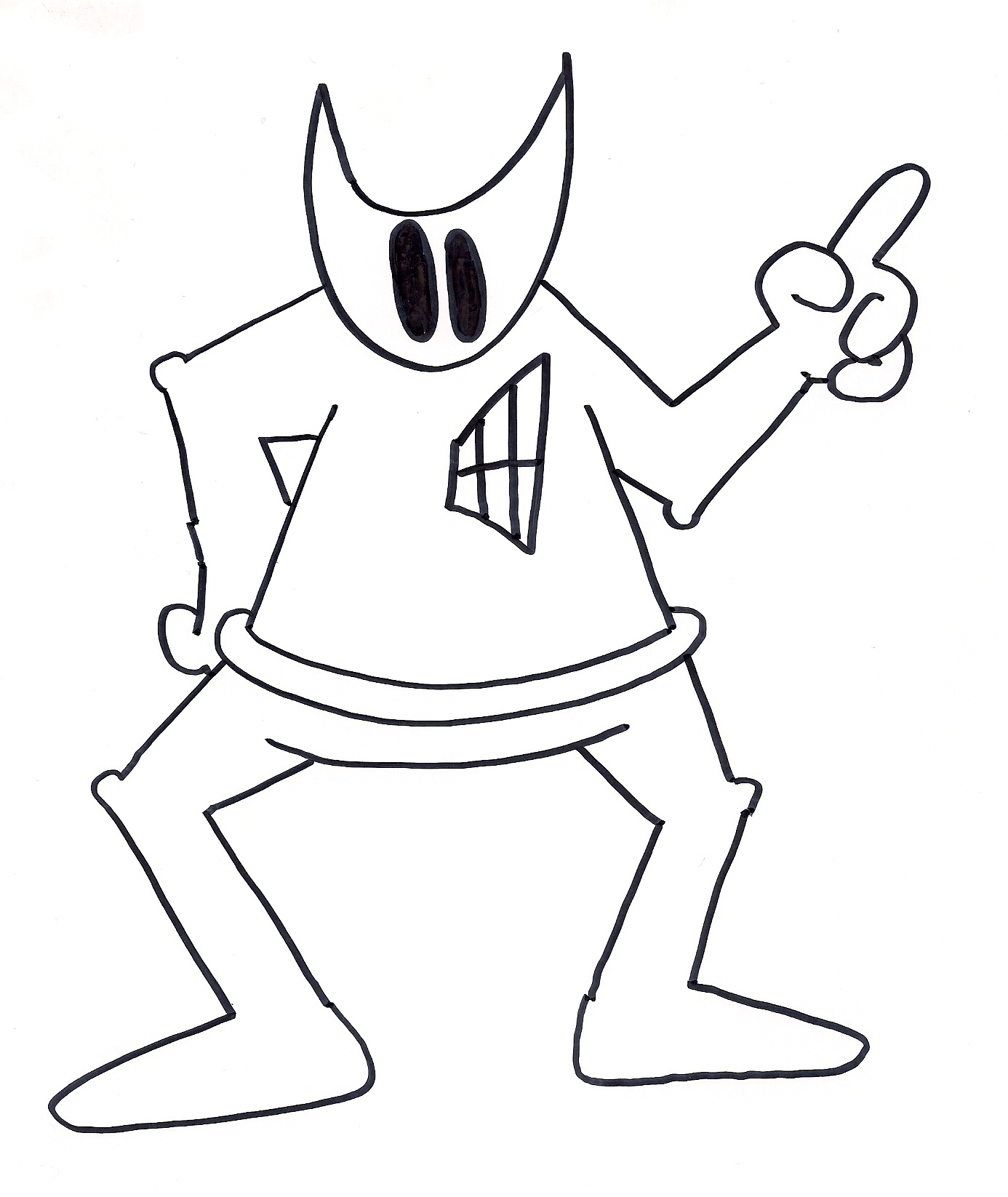
Skip’s Quips: Slamming the State of Serious ’70s Sci-Fi

Blog Sketch 082813Gosh, Rollerball is a mediocre movie.

I came to this realization after giving the Norman Jewison-helmed sci-fi flick yet another chance on Turner Classic Movies last night. It confirmed all my previous assessments: that it’s pretentious, tiresome and not as introspective as it thinks it is. The blame can partly fall on the script–which documents a future society in which corporations rule the world and sanction the violent, eponymous arena game–but it also features a lethargic performance by the usually reliable James Caan, slow-paced direction by Jewison (no, shots of people turning their heads to stare at the protagonist menacingly are not a substitute for character development) and dubious social commentary … most lamentably evidenced by a scene in which a posse of doltish partygoers representing, I assume, our worst inner voices, commit arboricide with the help of a rather powerful gun.

OK, I get it. Humans are bad. We like wars and killing trees. Fine.

We also like quality filmmaking–and Rollerball doesn’t cut it. The main problem, however, is that it could’ve been so much better, like so many other serious 1970s sci-fi flicks. Logan’s Run, A Boy and His Dog, Soylent Green … science fiction really had a lot to say in that era, but a scarce few films then aced the sniff test. I wish the folks behind them had taken the time to streamline the scripts, make the messaging less heavy-handed, kept the preaching to a minimum. Forbidden Planet‘s a benchmark. So is Paul Verhoeven’s Total Recall. Spare, concise screenplays, quick-flowing dialogue, tense direction. That’s all you want in a good sci-fi movie, and you don’t find that a lot in the “golden” age of the 1970s. Ideas are almost commonplace. Execution isn’t.

So why is that? I know that period heralded an age of cinematic risks, and many of the non-sci-fi films then exemplified that. Yet with the exception of pictures such as Fantastic Planet and A Clockwork Orange, many of these flicks don’t live up to their expectations. Yes, I know the 1970s also saw the debuts of Alien and Star Wars, but those are less like “message” movies than old-fashioned, leave-your-thinking-at-the-door entertainment.

Rollerball, at its core, is a message movie. And it doesn’t work. Does that mean sci-fi should be devoid of messages altogether–that it should stick to what it does best? (Read: lasers.)

I don’t think so. But it’s something I’ll ponder next time I watch one of these futuristic “man-must” movies. Man must do this, man must do that.

Man must make better science fiction films, methinks.