Skip’s Quips: Slamming the State of Serious ’70s Sci-Fi

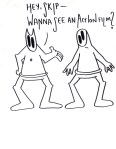
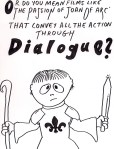
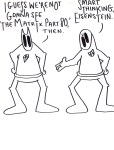
Blog Sketch 082813Gosh, Rollerball is a mediocre movie.

I came to this realization after giving the Norman Jewison-helmed sci-fi flick yet another chance on Turner Classic Movies last night. It confirmed all my previous assessments: that it’s pretentious, tiresome and not as introspective as it thinks it is. The blame can partly fall on the script–which documents a future society in which corporations rule the world and sanction the violent, eponymous arena game–but it also features a lethargic performance by the usually reliable James Caan, slow-paced direction by Jewison (no, shots of people turning their heads to stare at the protagonist menacingly are not a substitute for character development) and dubious social commentary … most lamentably evidenced by a scene in which a posse of doltish partygoers representing, I assume, our worst inner voices, commit arboricide with the help of a rather powerful gun.

OK, I get it. Humans are bad. We like wars and killing trees. Fine.

We also like quality filmmaking–and Rollerball doesn’t cut it. The main problem, however, is that it could’ve been so much better, like so many other serious 1970s sci-fi flicks. Logan’s Run, A Boy and His Dog, Soylent Green … science fiction really had a lot to say in that era, but a scarce few films then aced the sniff test. I wish the folks behind them had taken the time to streamline the scripts, make the messaging less heavy-handed, kept the preaching to a minimum. Forbidden Planet‘s a benchmark. So is Paul Verhoeven’s Total Recall. Spare, concise screenplays, quick-flowing dialogue, tense direction. That’s all you want in a good sci-fi movie, and you don’t find that a lot in the “golden” age of the 1970s. Ideas are almost commonplace. Execution isn’t.

So why is that? I know that period heralded an age of cinematic risks, and many of the non-sci-fi films then exemplified that. Yet with the exception of pictures such as Fantastic Planet and A Clockwork Orange, many of these flicks don’t live up to their expectations. Yes, I know the 1970s also saw the debuts of Alien and Star Wars, but those are less like “message” movies than old-fashioned, leave-your-thinking-at-the-door entertainment.

Rollerball, at its core, is a message movie. And it doesn’t work. Does that mean sci-fi should be devoid of messages altogether–that it should stick to what it does best? (Read: lasers.)

I don’t think so. But it’s something I’ll ponder next time I watch one of these futuristic “man-must” movies. Man must do this, man must do that.

Man must make better science fiction films, methinks.
Setter’s ‘Spectives: Let’s Put On a Movie-Inspired Show!

Setter Drawing for Blog 082613Do you remember the (sometimes) good old days when Hollywood turned Broadway musicals into motion pictures?

Yes, we still get that to some extent with Chicago, Phantom and others of their ilk. But, uh …

Well, but. It’s not the same, is it?

Definitely not the same is the trend to turn motion pictures into Broadway musicals. The Lion King is one example. Another’s Newsies. Even My Favorite Year got into the stagebound act (terribly, I might add).

What are we going to say about the cinema 20 years from now? “Hey, where were you when the film of the musical based on the movie The Producers came out?”

I know how I’d respond: “Me? I was watching the film of the opera based on the Beaumarchais play The Marriage of Figaro at the Met. After that, we ate at the restaurant spun off the novel based on the  video game inspired by … ”

Blah, blah, blah.

There’s something truly uninspired about creating a play or musical based on a movie–especially if the original’s a good one. Film’s not like theater; it’s permanent, constant. Actors don’t flub lines one night and get them perfectly the next. You’ve got a completed work.

So if the source movie’s good–as is the case with My Favorite Year and The Producers–why bother translating it for the stage? Shouldn’t we consider ourselves lucky that we have a film we can always return to, laugh at, quote the lines from? And isn’t that one of the main reasons why we can watch great movies over and over again … because we know them like we know our significant others, our families, our friends?

Because they never change?

That’s why I’m not interested in seeing any more Broadway shows based on films. The theater begs for interpretation, transformation; movies don’t. I’ll watch the motion picture version of Sunset Boulevard, not the musical, thank you very much. Because the latter, like so many of its kind, just isn’t ready for its close-up.

Skip’s Quips: The ‘Dog’ Fan Cometh

Blog Sketch 082813Guess what Turner Classic Movies was showing on the tube late last night.

If you said Un Chien Andalou, you win an ant-covered hand.

That’s right. Luis Buñuel’s bizarre, seminal 1929 short was appearing on the cable channel that’s also featured flicks starring Joan Crawford, Robert Wagner and the like.

Variety’s the spice of life, it seems. Or in Chien‘s case, maybe the razor.

I’ve got to admit, though–TCM definitely doesn’t pull any punches when it comes to the cinema. Its eclectic selection’s one of its hallmarks, and you’d be hard-pressed to find anything more eclectic than Buñuel’s Andalusian Dog.

I still remember hearing gasps during showings of this film at, I believe, New York’s Museum of Modern Art. The notorious scene where a man appears to slice a woman’s eyeball (it was actually a cow’s) still elicited a reaction after all these years.

I think the great Buñuel would’ve been tickled at that. He might even be amused that his Andalou was being showcased on a major cable channel.

And I can’t help but be pleased, too. This is a movie that everyone should see–a picture about nothing, filled with wild, nonsensical yet somehow connective images. It’s about filmmaking and the ability to tell a story without having one. It’s about art.

And art starred on TCM last night. Turner Classic Movies, I salute you.

Setter’s ‘Spectives: I Sing the Movie Romantic!

Setter Drawing for Blog 082613Every so often, I start thinking about Odd Man Out and how romantic the film is.

Yes, I’m talking about Odd Man Out, Carol Reed’s elegiac 1947 masterpiece about the “Troubles” in Northern Ireland. The one where James Mason’s dying gunman staggers from alley to alley after killing a man in a robbery. The one where Robert Newton plays a crazed painter aching to create a portrait of the doomed fellow. The one where Robert Krasker’s cinematography captures all of the shadows and snow cloaking Belfast’s forgotten corners.

That doesn’t sound romantic, you say. But it is, it truly is.

When you get to the end and watch Kathleen, the woman who loves Mason’s Johnny McQueen, make the decision to go with him on his predetermined journey, you might agree with me. Because they’re both incredibly flawed, often unlikable, even criminals–yet they overlook their faults for love.

By the way, I’m not advocating this behavior at all. As Sibella says in Kind Hearts and Coronets: “Not at all.” Johnny and Kathleen are just characters and not to be emulated–especially in light of the fact that they use violence to achieve their ends.

But their actions oddly remind me of another pair of I-don’t-care-about-anyone-else lovers, Heathcliff and Catherine in the towering novel Wuthering Heights. The idea that the connection between two people can be so strong that everyone else is immaterial is, to my mind, one of the most romantic and completely untenable notions around. That it exists, presumably, just in art is a blessing; anyone who apes Heathcliff in real life would be the most insufferable person around. Still, it informs the screen, with Johnny and Kathleen providing perfect examples of all-forgiving, all-consuming adoration.

And it makes a spellbinding story. Emily Brontë, I’m sure, knew that well.

I think about Odd Man Out most often when I’m mulling life beyond our own–not that on other planets, but on ours, in a movie that superficially is about political divisions yet really concerns people. It’s about humans’ insularity, how selfish we can be … and how personal our goals are. Maybe that’s what I like most about the film, that it shows us in all our disarray, in characters who are lost everywhere they go except together.

It doesn’t mean they’re right. It does, however, mean romance.

Skip’s Quips: Get Into the Groove, for You’ve Got to … Oh, Forget It

Blog Sketch 082813I’m so happy the musical has evolved into the 3D song-and-dance epic.

I mean, we were really slumming with films like Top Hat and My Fair Lady, right? You don’t want to have a plot and witty dialogue messing up all those steps.

Or, for that matter, anything interfering with a story of competition so fierce that the toughs in West Side Story will want to jump ship into Mary Poppins.

Yes, I’m curmudgeonly. Sure, I’m old-fashioned. And I still grouse over the genre’s move into rock ‘n’ roll.

But I do think we’ve dropped some of the excitement that went into the great musicals of the past–excitement that can’t be replaced with legs flying out three-dimensionally from the screen.

Just look at what has come out recently. Some of these formulaic motion-filled pictures hearken back to the timelessly terrible let’s-save-the-theater yarns of yore. Aren’t there enough screenwriters out there to infuse a lackluster script with some originality?

At this rate, I’ll take even a sequel to Madonna’s best foray into cinema.

The fact is, a musical isn’t complete without something other than feet supporting it. Good writing. A smart storyline. And, of course, terrific music.

Tales of a flash mob just ain’t gonna cut it.

So for those who believe you just gotta have a gimmick, I put it to you that entertainment’s more important. It’s not just about jumping over cars and hoofing in public. Give me a screenplay with clever dialogue, and I’ll watch. Only then will I want to face the music and dance.

Let’s Get Our Definitions Straight, OK?

Setter’s ‘Spectives: The ‘Wind’ Beneath My Consideration

Setter Drawing for Blog 082613I’m a Gone with the Wind denier.

I deny that it’s a great film. I deny that it’s even enjoyable. And I deny that it should be shown on TV as much as it has been … or, for that matter, at all.

Saturated with racism, it’s a relic that defies viewing. Someone should lock it up and store it away, à la Raiders of the Lost Ark. Yet every so often, it appears on the small screen, as if it’s a tradition akin to watching March of the Wooden Soldiers on Christmas.

Whose tradition are we following here? The tradition of offending people?

I believe in dissociating the creator from his or her art. But GwtW‘s so infused with cordial hate that it infects the film as a whole. You can’t separate the parts.

And I’m still wondering why it gets the green light on the tube.

Many people like it. Some feel it’s a masterpiece. I don’t. From a cinematic perspective, it smacks of tripe. Soapy, tiresome tripe. Oh, yeah: It’s long, too, and not long in a good, Lawrence of Arabia way. You feel every minute of it.

I’m in the minority on this, and normally I accept that. In this case, however, I don’t. GwtW shouldn’t be shown on TV, and its racism alone should be reason enough. The fact that it’s plain tedious offers further proof that we should blow it off.

Skip’s Quips: It’s Time to Call ‘The Band Wagon’ for What It Is

Blog Sketch 082813The other day, I came to a conclusion about the beloved Hollywood musical The Band Wagon.

Ready? Here it is.

I don’t like it as much as Singin’ in the Rain.

OK, big whoop. That’s like saying I don’t like foie gras as much as caviar. Honestly, they’re both top-notch films. They both have terrific scripts. They both have rollicking numbers.

But after years of viewing The Band Wagon, I noticed that some of the songs just aren’t up to par. Take “Louisiana Hayride,” for instance. Or “Triplets.”

As Mad Magazine‘s Alfred E. Neuman might opine: “Ecch!”

“Triplets” is a particular puzzlement. Why is this corny, unfunny number so vaunted in the annals of…well, corny, unfunny numbers? It’s dull. It’s forced. It tries too hard. The verdict: phooey.

Same with “Louisiana Hayride.” If I told you how cheesy I thought this bit of idealized Americana is, you might run for a scraper and some quince paste.

The fact is, The Band Wagon is good enough to make these tiresome numbers an afterthought. “That’s Entertainment,” of course, is a showstopper. And the “Girl Hunt Ballet” is a lot of fun. But I don’t think it measures up to Singin’ in the Rain‘s economy, let alone the charm of the songs. Plus, the latter flick’s got better cinematography. Some of the shots in The Band Wagon look strangely drab.

So in conclusion, this arbiter of Superb Movie Musicals has to drop a personal favorite down from its former perch. Just a notch below, but enough to make me wonder if something that’s entertainment can really compete with another thing that’s art.

Setter’s ‘Spectives: Sympathy for the Movies’ Devils

Setter Drawing for Blog 082613To lift (and thoroughly mangle) a line from the Wallace Stevens poem Thirteen Ways of Looking at a Blackbird: I do not know which to prefer, the beauty of an irredeemable movie villain or one with nuance and definition.

On the one hand, I believe a great portrayal of a vile, two-dimensionally loathsome evildoer can make a film–Dirty Harry is one example, with Andy Robinson’s sinister “Scorpio” killer giving viewers every reason to boo him. But then you have pictures such as M and Precious,  whose ghastly, repellent villains both get speeches at the end that aim to suggest they remain human … despite their horrific acts.

Not surprisingly, those last two films are a lot harder to watch than Dirty Harry–or, for that matter, any other flick with baddies you love to hate. And I think it’s because making a choice about a character is much more difficult than having one already made for you.

There’s definitely a time and place for movies with clear-cut antagonists. Sometimes, these films can be masterpieces: The Lord of the Rings: The Return of the King offers evidence of this. Yet the main evildoer, Sauron, is hardly well defined. He’s just … evil. Even Darth Vader from Star Wars shows more love than mean old Sauron. You can blame the great actor James Earl Jones for infusing Vader’s voice with character.

Giving a frightening villain more than one shade doesn’t always work, and it’s not right for every movie. But good directors can make unwieldy things fit while asking questions you don’t want to answer. Alfred Hitchcock did just that in Strangers on a Train and Frenzy, both of which have scenes where the killers frantically try to retrieve misplaced pieces of evidence. Hitch makes us almost feel for these creeps as he forces us to watch their travails. That’s manipulative, folks–manipulative to the nth degree. But it’s something only a great artist can do.

Ultimately, characters with multiple dimensions–whether they’re good or evil–add heft to a movie. It may not be a heft you enjoy, but it’s solid nonetheless and often points to a film’s quality. That doesn’t mean you’ll want to watch them over and over to see if the villain gets his or her due, but it suggests that there’s something more about the picture than providing “you-must-pay-the-rent” thrills.

That’s risk in my book, and filmmakers who take it for art’s sake deserve a hand.

Skip’s Quips: Cinema of the Irritating

Blog Sketch 082813A long time ago, in a galaxy far, far away (well, Manhattan), I was told by an otherwise rational budding critic that Jean-Luc Godard was the real French New Wave director–not François Truffaut.

In the words of Michael Caine’s character Peachy Carnehan in The Man Who Would Be King: “Pardon me while I fall down laughing.”

Yes, this was told to me in all seriousness, with the utmost authority. I guess if you make movies that are too enjoyable, it’s trendy to discount them in favor of more “experimental” cinema.

Frankly, I like to be entertained. And in general, Truffaut’s body of work is light-years more entertaining than Godard’s–Breathless aside.

You’re right: The critic’s point was that Godard was more of a New Wave exponent than Truffaut … not necessarily a better filmmaker (although I think that was implied). Yet I’ll have to disagree with this, too. Truffaut’s edgy cuts, intimate camera, and use of tricks ranging from irises to freeze-frames invigorated the cinema, bringing it close to an accessible, pertinent ideal. That his films are greater, in general, than Godard’s is just gravy. It’s François I think of when I think of La Nouvelle Vague, not Jean-Luc.

Do I consider Breathless a hallmark of world cinema? Of course. But I consider it a Truffaut film, anyway. Sans François, Godard’s films aren’t as good–and often veer on the irritating.

To be a “real” artist in any medium, one must excel in the field. That’s why I also prefer Alban Berg’s compositions to Arnold Schoenberg’s–despite the latter’s involvement in the development of 12-tone music. And I like Picasso’s art more than Braque’s, though they both had a hand in Cubism. The greater creator is the real one, the one whose works you’d rather absorb.

At least, that’s my reality. Is it everyone’s?

Ha. In my dreams.