Skip’s Quips: The ‘Dog’ Fan Cometh

Blog Sketch 082813Guess what Turner Classic Movies was showing on the tube late last night.

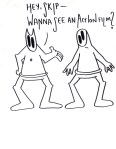
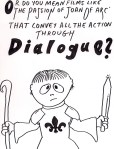
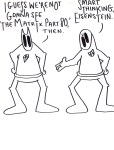
If you said Un Chien Andalou, you win an ant-covered hand.

That’s right. Luis Buñuel’s bizarre, seminal 1929 short was appearing on the cable channel that’s also featured flicks starring Joan Crawford, Robert Wagner and the like.

Variety’s the spice of life, it seems. Or in Chien‘s case, maybe the razor.

I’ve got to admit, though–TCM definitely doesn’t pull any punches when it comes to the cinema. Its eclectic selection’s one of its hallmarks, and you’d be hard-pressed to find anything more eclectic than Buñuel’s Andalusian Dog.

I still remember hearing gasps during showings of this film at, I believe, New York’s Museum of Modern Art. The notorious scene where a man appears to slice a woman’s eyeball (it was actually a cow’s) still elicited a reaction after all these years.

I think the great Buñuel would’ve been tickled at that. He might even be amused that his Andalou was being showcased on a major cable channel.

And I can’t help but be pleased, too. This is a movie that everyone should see–a picture about nothing, filled with wild, nonsensical yet somehow connective images. It’s about filmmaking and the ability to tell a story without having one. It’s about art.

And art starred on TCM last night. Turner Classic Movies, I salute you.

Let’s Get Our Definitions Straight, OK?

Setter’s ‘Spectives: The ‘Wind’ Beneath My Consideration

Setter Drawing for Blog 082613I’m a Gone with the Wind denier.

I deny that it’s a great film. I deny that it’s even enjoyable. And I deny that it should be shown on TV as much as it has been … or, for that matter, at all.

Saturated with racism, it’s a relic that defies viewing. Someone should lock it up and store it away, à la Raiders of the Lost Ark. Yet every so often, it appears on the small screen, as if it’s a tradition akin to watching March of the Wooden Soldiers on Christmas.

Whose tradition are we following here? The tradition of offending people?

I believe in dissociating the creator from his or her art. But GwtW‘s so infused with cordial hate that it infects the film as a whole. You can’t separate the parts.

And I’m still wondering why it gets the green light on the tube.

Many people like it. Some feel it’s a masterpiece. I don’t. From a cinematic perspective, it smacks of tripe. Soapy, tiresome tripe. Oh, yeah: It’s long, too, and not long in a good, Lawrence of Arabia way. You feel every minute of it.

I’m in the minority on this, and normally I accept that. In this case, however, I don’t. GwtW shouldn’t be shown on TV, and its racism alone should be reason enough. The fact that it’s plain tedious offers further proof that we should blow it off.

Skip’s Quips: It’s Time to Call ‘The Band Wagon’ for What It Is

Blog Sketch 082813The other day, I came to a conclusion about the beloved Hollywood musical The Band Wagon.

Ready? Here it is.

I don’t like it as much as Singin’ in the Rain.

OK, big whoop. That’s like saying I don’t like foie gras as much as caviar. Honestly, they’re both top-notch films. They both have terrific scripts. They both have rollicking numbers.

But after years of viewing The Band Wagon, I noticed that some of the songs just aren’t up to par. Take “Louisiana Hayride,” for instance. Or “Triplets.”

As Mad Magazine‘s Alfred E. Neuman might opine: “Ecch!”

“Triplets” is a particular puzzlement. Why is this corny, unfunny number so vaunted in the annals of…well, corny, unfunny numbers? It’s dull. It’s forced. It tries too hard. The verdict: phooey.

Same with “Louisiana Hayride.” If I told you how cheesy I thought this bit of idealized Americana is, you might run for a scraper and some quince paste.

The fact is, The Band Wagon is good enough to make these tiresome numbers an afterthought. “That’s Entertainment,” of course, is a showstopper. And the “Girl Hunt Ballet” is a lot of fun. But I don’t think it measures up to Singin’ in the Rain‘s economy, let alone the charm of the songs. Plus, the latter flick’s got better cinematography. Some of the shots in The Band Wagon look strangely drab.

So in conclusion, this arbiter of Superb Movie Musicals has to drop a personal favorite down from its former perch. Just a notch below, but enough to make me wonder if something that’s entertainment can really compete with another thing that’s art.

Setter’s ‘Spectives: Sympathy for the Movies’ Devils

Setter Drawing for Blog 082613To lift (and thoroughly mangle) a line from the Wallace Stevens poem Thirteen Ways of Looking at a Blackbird: I do not know which to prefer, the beauty of an irredeemable movie villain or one with nuance and definition.

On the one hand, I believe a great portrayal of a vile, two-dimensionally loathsome evildoer can make a film–Dirty Harry is one example, with Andy Robinson’s sinister “Scorpio” killer giving viewers every reason to boo him. But then you have pictures such as M and Precious,  whose ghastly, repellent villains both get speeches at the end that aim to suggest they remain human … despite their horrific acts.

Not surprisingly, those last two films are a lot harder to watch than Dirty Harry–or, for that matter, any other flick with baddies you love to hate. And I think it’s because making a choice about a character is much more difficult than having one already made for you.

There’s definitely a time and place for movies with clear-cut antagonists. Sometimes, these films can be masterpieces: The Lord of the Rings: The Return of the King offers evidence of this. Yet the main evildoer, Sauron, is hardly well defined. He’s just … evil. Even Darth Vader from Star Wars shows more love than mean old Sauron. You can blame the great actor James Earl Jones for infusing Vader’s voice with character.

Giving a frightening villain more than one shade doesn’t always work, and it’s not right for every movie. But good directors can make unwieldy things fit while asking questions you don’t want to answer. Alfred Hitchcock did just that in Strangers on a Train and Frenzy, both of which have scenes where the killers frantically try to retrieve misplaced pieces of evidence. Hitch makes us almost feel for these creeps as he forces us to watch their travails. That’s manipulative, folks–manipulative to the nth degree. But it’s something only a great artist can do.

Ultimately, characters with multiple dimensions–whether they’re good or evil–add heft to a movie. It may not be a heft you enjoy, but it’s solid nonetheless and often points to a film’s quality. That doesn’t mean you’ll want to watch them over and over to see if the villain gets his or her due, but it suggests that there’s something more about the picture than providing “you-must-pay-the-rent” thrills.

That’s risk in my book, and filmmakers who take it for art’s sake deserve a hand.

If Only These Famous Movie Lines Had Turned Out Thusly …

Setter’s ‘Spectives: ‘Psycho’ Viewers, Qu’est-ce Que C’est?

Setter Drawing for Blog 082613Watching Alfred Hitchcock’s inimitable scare-fest Psycho last night on TV thrilled me more than it ever has in the past.

Why? Well, for one thing, I didn’t like it.

Yes, that’s thrilling. Really. Because last night, the reason became apparent.

It’s a negative movie. It’s oddly structured. The dialogue is bizarre. And Hitch spends a heckuva lot of time showing you these seemingly “mundane” details, like Janet Leigh packing and unpacking her suitcase and Anthony Perkins cleaning up the bathroom after he has dispatched her.

All of this is deliberate. I’m not saying Hitchcock wasn’t in command. But it’s almost as if the great director was trying to call attention to ordinary activities that aren’t normally seen in the movies.

That helps develop character…and I think that’s why the film’s so effective. Perkins’ obsessive mopping and post-murder preparations reveal how deeply disturbed he is, while Leigh’s behavior suggests an interior schism over the money she’s stolen. It’s all brilliantly done, and it’s an incredibly watchable movie, despite all of the minutiae.

Yet I still don’t like it. It seems more experimental to me than many of the master’s other pictures, a grim, stark-looking study rather than a finished product. Again: I don’t think anything is loose, here; Hitch was in control through and through. But for me, it’s hard to watch. I’d rather sit down to a viewing of The 39 Steps, you know?

Something where you don’t feel like you have to take a shower afterward.

Skip’s Quips: At Least They Didn’t Make a Movie About ‘Mr. Do!’

Blog Sketch 082813Have we come to the end of the line for movies based on video games?

That’s certainly my hope. I don’t think I could sit through another installment of Mortal Kombat.

Guess I should be glad they didn’t make a flick about Frogger. Or should I bite my tongue?

I can see the tagline now: “The existential adventures of a frog who only wants to get to the other side.”

I wonder, though, if the moviegoing public has seen enough of this type of thing. After all, video games these days are more cinematic than ever, with plotlines and entire scenes developed through computer-generated animation. No one really needs a film based on a game that’s like a film anyway.

Don’t get me wrong: I’m not a video-game teetotaler. I actually grew up with them during their nascent days. Donkey Kong, Zaxxon. I even had a ColecoVision.

But I enjoyed them for their interactivity. That was a novel thing–to compete against your computer. Nowadays, video games are as much about watching the characters as much as playing them.

And I have to say, I find that interesting. Because the more, it seems, we gravitate toward a new technology and new experiences, the more we want the old incorporated into it.

Looking for movies in video games is perfectly natural. It’s like wanting to know more about Mozart and how he got his inspiration. The interest in the games spawns an interest in the characters.

Yet motion pictures based on these characters seem, for the most part, unsuccessful. There’s only so much we can get from a shoot-’em-up. Within the context of the games themselves, however, the cinematic qualities work. So perhaps that’s where they belong.

Now, if you’ll excuse me, I have to check my officers’ progress in Star Trek Online. Exit, pursued by a joystick.

Setter’s ‘Spectives: Musings on Herzog, ‘Aguirre’ and General Zaniness

Setter Drawing for Blog 082613I don’t love all of Werner Herzog’s movies, but I have to tell ya: He’s cut in a truly original mold.

A recent viewing of Werner Herzog Eats His Shoe on Turner Classic Movies got me thinking about the oft-brilliant, sometimes-obsessive and frequently zany director and his oeuvre, which includes one of my favorite films, Aguirre, the Wrath of God. It’s a movie that defines him in a sense–a superbly shot, hauntingly scored (the dreamlike, pulsating music was crafted by Popul Vuh) picture about megalomania and how it can carry, and ultimately destroy, human endeavors. The megalomaniac in question is Aguirre himself, a crazed, based-on-a-real-person conquistador played with frightening abandon by Klaus Kinski, who teeters, glowers and broods throughout the flick as he carries out a mutiny of a 16th-century Spanish expedition to find gold amid the Amazonian jungle. As I remembered the great moments that characterized this adventure, I wondered if only a person as mad as Aguirre himself could make it, capturing hallucinogenic images such as a line of soldiers and their retinue struggling to climb down a verdant, mist-covered mountain, a head continuing to count numbers even after its owner has been decapitated, and the final scenes in which Aguirre, his doomed raft overrun by monkeys, talks to no one about his plans for global domination…no one, because everyone in his party is dead, a fact revealed memorably by the famous, swooping shot at the end.

But Herzog isn’t mad. I think he’s quite sane, though I wonder if he likes the thought that people may think he’s mad. Really, he’s an old-fashioned showman with magnificent obsessions and a talent for promoting idea-rich films made on low budgets. And I value this image he’s cultivated, because we don’t see a lot of it. It’s a mix of Hitchcock’s talent for marketing with Kurosawa’s quest for perfection, and the stories Herzog tells about his exploits rival the great ones in the cinematic lexicon–including the one about Kurosawa ordering the set of Throne of Blood to be rebuilt because he saw a nail that wouldn’t have been there during the period in which the movie takes place.

That’s not madness, folks. It’s art, and it suggests a commitment to its creation that only the most dedicated craftsmen have.

I wish there were more filmmakers like Herzog around these days, filmmakers who take risks and know how to advertise themselves. Yet there’s only one Herzog, and I think we have to be content with that. I’m certainly pleased that he gave us Aguirre, though I realize that if there’s anything that defines its creator, it’s not madness but determination and a need to produce art.

Thank you, then, Werner Herzog.

Skip’s Quips: Of Titles and Trollope

Blog Sketch 082813Back in the day–and I mean back, at a time when I thought Ralph Bakshi’s Lord of the Rings was the definitive version–I perused my parents’ bookshelves frequently in search of tomes with curious titles. A particular favorite: Is He Popenjoy?, an Anthony Trollope novel that, as a child, I couldn’t fathom reading but nevertheless intrigued me as I wondered if the character was indeed, well, Popenjoy.

Years later, I realized what had struck me about the title. It’s pressing, insistent. combining an unusual name with a terse question–making you want to find the answer.

I think a lot of filmmakers today could learn from old Trollope.

All right–bad titles aren’t necessarily a modern malady. They’ve existed even before They Knew What They Wanted debuted in 1940. But I think there’s a relatively recent tendency to drop the intrigue in movie monikers and take the easy way out. Just look at the past decade’s slate of Meet the [Silly/Generic Surname Here] flicks. Danger, Will Robinson. Dreary trend ahead.

I guess it’s a positive that filmmakers have eased up on putting exclamation points in their movie titles or experimenting with the excruciatingly wacky names that were so prevalent in the 1960s and ’70s. Yet we still get stuff like Fled and We’re the Millers, where the labels are either awkward (the former) or obvious (guess) while lacking any hook. True, that may not matter when it comes to popularity–Millers is evidence of that–but when it comes to quality cinema, don’t we want a title that can grab us? Shouldn’t it give us an idea of why we’d want to see the movie it’s tied to…without telling us too much?

I don’t think a film will necessarily be lousy if it doesn’t have an interesting title. But it’s hard for me not to judge a DVD by its case. Today, as I recall my times examining volumes on my parents’ bookshelf, I wonder if Trollope would agree with me on the importance of naming movies–adaptations of his works included.

Somehow, I don’t think Meet Popenjoy would fly.