It’s not lazy—it’s being opinionated!

Skip’s Quips: Paris, Je T’Aime … Uh, Most of the Time

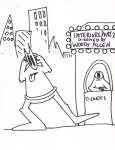
Blog Sketch 082813One of my fondest cinematic memories is seeing a line outside a Paris movie theater for a Marx Brothers flick.

The Marx Brothers. A line. For a film that was, at the time, at least 60 years old.

See why I love France so much?

OK, perhaps the infatuation with Jerry Lewis–one of the silver screen’s least funny performers–doesn’t make sense, though I have to admit liking his Gallic equivalent, Louis de Funès, quite a bit. (Watch The Mad Adventures of Rabbi Jacob and see if you agree.) Yet the truth is, there’s a film culture there that pervades the national fabric. Why? More than a century of cinematic prowess is one reason, but I think another is the notion that people just like movies there. Good movies. Old movies. And often new movies.

Many years ago, as I attempted to coordinate a showing of the original 1968 version of The Producers in my college dorm, a friend of mine pooh-poohed the idea, decrying the film’s “old humor.” True, not everyone shares those sentiments, but I wondered then–as I do now–why some feel nothing that’s been around more than 10 minutes has any value cinematically. Doesn’t quality last longer than novelty … at least, in most cases?

I’m not deluding myself: There’s no way every person in France likes the Marx Brothers or, for that matter, any old movie because of its age. Bad taste is everywhere–the admiration of les films de M. Lewis offers evidence of that–yet I think there’s a sensibility in France that suggests its inhabitants often understand what it takes to make a good movie … and why it should be valued regardless of the years behind it. Again, I’m not sure why this is, and I’m not saying one country’s better than another.

But when I summon up remembrance of movies past, I think of the line outside that French theater to see a Marx Brothers comedy. And I can’t help but find a love in my heart for Paree.


A Skip and Setter Q&A: The Ancient Art of Swearing

Skip and Setter QandA Sketch 092213At a recent imaginary panel that didn’t happen at any industry conference we know of, Skip and Setter locked horns on the topic of profanity and why it’s so prevalent in movies today. The following is an excerpt from their overlong, admittedly tiresome debate.

Skip: You’ve said in the past that you like seeing profanity in movies because it calls attention to the need to upgrade the English language. Are you deliberately ignoring the fact that many venerated writers–from Ben Jonson to e.e. cummings–have used vulgarity in their works? English doesn’t need upgrading!

Setter: You’re so misinformed. I’m talking about profanity when it’s used to replace inspired dialogue. As in every flick these days that tries to emulate Pulp Fiction. I’m not talking about profanity with a purpose.

Skip: Well, don’t you think all profanity has a purpose–as long as it’s in character?

Setter: No. Read my latest book.

Skip: I’m not reading your book, dude. I hate your writing.

Setter: Well, I outline my “Theory of Profanity” there. It basically states that it’s cooler to say a swear word in a movie than to get a “G” rating.

Skip: So you’re against overusing profanity.

Setter: Sure. Unless it concerns your reviews.

Skip: I love you, too. Now, why don’t you think the vulgarity-filled sports film has survived? Slap Shot, Major League? Seems like more folks want to do a film about profane, hipper-than-thou mobsters than they do locker-room sagas.

Setter: They’ll be back. I think people are afraid of seeing depictions of the way hallowed sports figures really talk. But they’re generally more credible than watching the story of a hired assassin who likes Schubert.

Skip: Sounds like a double standard. As long as it’s not believable, it’s OK to use profanity.

Setter: Maybe. Read my latest book.

Skip: No thanks. Anyway, profanity’s part of our lexicon. It’s been around for centuries.

Setter: Doesn’t mean we should use it. Look at the Hays Code era. Lots of great movies were made without profanity.

Skip: And lots of junk came out, too. Ever see Turnabout? Blecch.

Setter: For every one of those, there’s a Casablanca. See my point? You don’t need a swear word to make a good movie.

Skip: It might sell more tickets.

Setter: It might. Read my latest book.

Skip: To channel e.e. cummings: “I will not read your CENSORED book.”

Setter: Pompous CENSORED.

Setter’s ‘Spectives: Let’s Put On a Movie-Inspired Show!

Setter Drawing for Blog 082613Do you remember the (sometimes) good old days when Hollywood turned Broadway musicals into motion pictures?

Yes, we still get that to some extent with Chicago, Phantom and others of their ilk. But, uh …

Well, but. It’s not the same, is it?

Definitely not the same is the trend to turn motion pictures into Broadway musicals. The Lion King is one example. Another’s Newsies. Even My Favorite Year got into the stagebound act (terribly, I might add).

What are we going to say about the cinema 20 years from now? “Hey, where were you when the film of the musical based on the movie The Producers came out?”

I know how I’d respond: “Me? I was watching the film of the opera based on the Beaumarchais play The Marriage of Figaro at the Met. After that, we ate at the restaurant spun off the novel based on the  video game inspired by … ”

Blah, blah, blah.

There’s something truly uninspired about creating a play or musical based on a movie–especially if the original’s a good one. Film’s not like theater; it’s permanent, constant. Actors don’t flub lines one night and get them perfectly the next. You’ve got a completed work.

So if the source movie’s good–as is the case with My Favorite Year and The Producers–why bother translating it for the stage? Shouldn’t we consider ourselves lucky that we have a film we can always return to, laugh at, quote the lines from? And isn’t that one of the main reasons why we can watch great movies over and over again … because we know them like we know our significant others, our families, our friends?

Because they never change?

That’s why I’m not interested in seeing any more Broadway shows based on films. The theater begs for interpretation, transformation; movies don’t. I’ll watch the motion picture version of Sunset Boulevard, not the musical, thank you very much. Because the latter, like so many of its kind, just isn’t ready for its close-up.

Setter’s ‘Spectives: The ‘Wind’ Beneath My Consideration

Setter Drawing for Blog 082613I’m a Gone with the Wind denier.

I deny that it’s a great film. I deny that it’s even enjoyable. And I deny that it should be shown on TV as much as it has been … or, for that matter, at all.

Saturated with racism, it’s a relic that defies viewing. Someone should lock it up and store it away, à la Raiders of the Lost Ark. Yet every so often, it appears on the small screen, as if it’s a tradition akin to watching March of the Wooden Soldiers on Christmas.

Whose tradition are we following here? The tradition of offending people?

I believe in dissociating the creator from his or her art. But GwtW‘s so infused with cordial hate that it infects the film as a whole. You can’t separate the parts.

And I’m still wondering why it gets the green light on the tube.

Many people like it. Some feel it’s a masterpiece. I don’t. From a cinematic perspective, it smacks of tripe. Soapy, tiresome tripe. Oh, yeah: It’s long, too, and not long in a good, Lawrence of Arabia way. You feel every minute of it.

I’m in the minority on this, and normally I accept that. In this case, however, I don’t. GwtW shouldn’t be shown on TV, and its racism alone should be reason enough. The fact that it’s plain tedious offers further proof that we should blow it off.

Skip’s Quips: It’s Time to Call ‘The Band Wagon’ for What It Is

Blog Sketch 082813The other day, I came to a conclusion about the beloved Hollywood musical The Band Wagon.

Ready? Here it is.

I don’t like it as much as Singin’ in the Rain.

OK, big whoop. That’s like saying I don’t like foie gras as much as caviar. Honestly, they’re both top-notch films. They both have terrific scripts. They both have rollicking numbers.

But after years of viewing The Band Wagon, I noticed that some of the songs just aren’t up to par. Take “Louisiana Hayride,” for instance. Or “Triplets.”

As Mad Magazine‘s Alfred E. Neuman might opine: “Ecch!”

“Triplets” is a particular puzzlement. Why is this corny, unfunny number so vaunted in the annals of…well, corny, unfunny numbers? It’s dull. It’s forced. It tries too hard. The verdict: phooey.

Same with “Louisiana Hayride.” If I told you how cheesy I thought this bit of idealized Americana is, you might run for a scraper and some quince paste.

The fact is, The Band Wagon is good enough to make these tiresome numbers an afterthought. “That’s Entertainment,” of course, is a showstopper. And the “Girl Hunt Ballet” is a lot of fun. But I don’t think it measures up to Singin’ in the Rain‘s economy, let alone the charm of the songs. Plus, the latter flick’s got better cinematography. Some of the shots in The Band Wagon look strangely drab.

So in conclusion, this arbiter of Superb Movie Musicals has to drop a personal favorite down from its former perch. Just a notch below, but enough to make me wonder if something that’s entertainment can really compete with another thing that’s art.

Skip’s Quips: At Least They Didn’t Make a Movie About ‘Mr. Do!’

Blog Sketch 082813Have we come to the end of the line for movies based on video games?

That’s certainly my hope. I don’t think I could sit through another installment of Mortal Kombat.

Guess I should be glad they didn’t make a flick about Frogger. Or should I bite my tongue?

I can see the tagline now: “The existential adventures of a frog who only wants to get to the other side.”

I wonder, though, if the moviegoing public has seen enough of this type of thing. After all, video games these days are more cinematic than ever, with plotlines and entire scenes developed through computer-generated animation. No one really needs a film based on a game that’s like a film anyway.

Don’t get me wrong: I’m not a video-game teetotaler. I actually grew up with them during their nascent days. Donkey Kong, Zaxxon. I even had a ColecoVision.

But I enjoyed them for their interactivity. That was a novel thing–to compete against your computer. Nowadays, video games are as much about watching the characters as much as playing them.

And I have to say, I find that interesting. Because the more, it seems, we gravitate toward a new technology and new experiences, the more we want the old incorporated into it.

Looking for movies in video games is perfectly natural. It’s like wanting to know more about Mozart and how he got his inspiration. The interest in the games spawns an interest in the characters.

Yet motion pictures based on these characters seem, for the most part, unsuccessful. There’s only so much we can get from a shoot-’em-up. Within the context of the games themselves, however, the cinematic qualities work. So perhaps that’s where they belong.

Now, if you’ll excuse me, I have to check my officers’ progress in Star Trek Online. Exit, pursued by a joystick.

Setter’s ‘Spectives: Musings on Herzog, ‘Aguirre’ and General Zaniness

Setter Drawing for Blog 082613I don’t love all of Werner Herzog’s movies, but I have to tell ya: He’s cut in a truly original mold.

A recent viewing of Werner Herzog Eats His Shoe on Turner Classic Movies got me thinking about the oft-brilliant, sometimes-obsessive and frequently zany director and his oeuvre, which includes one of my favorite films, Aguirre, the Wrath of God. It’s a movie that defines him in a sense–a superbly shot, hauntingly scored (the dreamlike, pulsating music was crafted by Popul Vuh) picture about megalomania and how it can carry, and ultimately destroy, human endeavors. The megalomaniac in question is Aguirre himself, a crazed, based-on-a-real-person conquistador played with frightening abandon by Klaus Kinski, who teeters, glowers and broods throughout the flick as he carries out a mutiny of a 16th-century Spanish expedition to find gold amid the Amazonian jungle. As I remembered the great moments that characterized this adventure, I wondered if only a person as mad as Aguirre himself could make it, capturing hallucinogenic images such as a line of soldiers and their retinue struggling to climb down a verdant, mist-covered mountain, a head continuing to count numbers even after its owner has been decapitated, and the final scenes in which Aguirre, his doomed raft overrun by monkeys, talks to no one about his plans for global domination…no one, because everyone in his party is dead, a fact revealed memorably by the famous, swooping shot at the end.

But Herzog isn’t mad. I think he’s quite sane, though I wonder if he likes the thought that people may think he’s mad. Really, he’s an old-fashioned showman with magnificent obsessions and a talent for promoting idea-rich films made on low budgets. And I value this image he’s cultivated, because we don’t see a lot of it. It’s a mix of Hitchcock’s talent for marketing with Kurosawa’s quest for perfection, and the stories Herzog tells about his exploits rival the great ones in the cinematic lexicon–including the one about Kurosawa ordering the set of Throne of Blood to be rebuilt because he saw a nail that wouldn’t have been there during the period in which the movie takes place.

That’s not madness, folks. It’s art, and it suggests a commitment to its creation that only the most dedicated craftsmen have.

I wish there were more filmmakers like Herzog around these days, filmmakers who take risks and know how to advertise themselves. Yet there’s only one Herzog, and I think we have to be content with that. I’m certainly pleased that he gave us Aguirre, though I realize that if there’s anything that defines its creator, it’s not madness but determination and a need to produce art.

Thank you, then, Werner Herzog.

It Happens Every Fall…Except It Doesn’t Really

Setter’s ‘Spective: When Filmmakers Lose Their Zip

Setter Drawing for Blog 082613Willie Mays and Alfred Hitchcock had a lot in common.

“Huh?” you say. “Stop kidding me.”

But it’s true. Both started inauspiciously: Hitch with silent films, Mays on the baseball diamond. Neither hit their stride until a few years into their careers, and then they produced brilliantly season after season until declining in their later days.

And no, I don’t think Family Plot holds a candle to the master’s greatest works. Same with Mays’ Mets experience. You got flashes of their old selves, but they couldn’t bring back everything. Ultimately, what you retained was nostalgia.

And that’s what I’m thinking about many other talented filmmakers. They often peak like athletes, then may lose their inspiration, as a pitcher loses his fastball or a hitter loses his bat speed. This happened, I feel, to Akira Kurosawa, François Truffaut. And I think it’s happening to Martin Scorsese.

I’m concerned that this terrific American director has already given us his masterpieces–that we’ll have to be content with flicks like Shutter Island and Gangs of New York: flawed, intermittently enjoyable movies that lack the risks taken in his greatest works (Mean Streets, Raging Bull and Goodfellas are three examples). You still see that fluid camerawork in his movies, those crisp cuts, but the cohesiveness and definition that marked his earlier films aren’t there.

I’m sad about this, but I understand. I think it’s quite natural. You rarely find a director or an athlete who produces through the end of his or her career. Luis Buñuel, I think was one, as was Ted Williams. But they don’t appear often. Most humans ultimately decline.

I’m not saying Scorsese should stop making movies or that his career is over. Far from it. Frankly, I hope he crafts hit after hit after hit. But it’ll be hard for him to match the quality of his output from the 1970s to the mid-1990s.

You may tell me it isn’t fair to expect that–that he’s evolved as a filmmaker. I’ll agree. It isn’t fair.

Yet you always expect a home run from your hero, right?

Me, I always do.